
Introduction: The Difference Between Choosing and Choosing Correctly
When international patients search for the best dental implant clinic Vietnam, most of them believe they are making a rational decision by comparing prices, reading reviews, or looking at before–after images. In reality, those are only surface indicators. Implant dentistry is not a consumer service—it is a complex medical intervention that requires long-term thinking.
The truth is uncomfortable but important:
Many implant failures do not happen because the clinic is “bad,” but because the patient did not know what to ask before treatment.
This article is not written to recommend a clinic. It is written to train you to think like a specialist, so that when you step into any consultation room in Vietnam, you are no longer a passive patient—but an informed decision-maker.
1. The First Question You Must Ask: “Are You Legally Qualified to Treat Me?”
Before discussing implants, technology, or price, you must begin with the most fundamental layer: legal legitimacy.
A serious dental clinic must be able to clearly present two things:
- Its operating license issued by health authorities
- The practicing certificates of the dentists involved in your treatment
This is not a formality—it is the minimum safety boundary. A clinic that hesitates, avoids, or becomes uncomfortable when asked about licensing is already giving you a signal.
For foreign patients, this step is even more critical. You are entering a healthcare system that is not your own. You must rely not on assumptions, but on verifiable documentation.


2. The Most Important Question: “Can You Show Me My Treatment Plan in Detail?”
If there is one question that separates an informed patient from an uninformed one, it is this.
A true implant clinic should not simply “explain verbally.” It should present a structured treatment plan that allows you to understand the entire journey before it begins.
A proper plan must answer the following, not in vague terms, but with specificity:
- How many implants will be placed, and why that number is chosen
- Where exactly they will be placed, based on 3D imaging
- What type of restoration will be used (single crown, bridge, full arch)
- What type of prosthetic system will be applied
- How long the entire treatment will take
- How many visits are required, and how far apart they are
- How long each visit will last
- The total cost, including all components—not an estimate, but a structured financial plan

Why is this so important?
Because implant dentistry is not about what happens on the day of surgery. It is about everything that happens before and after. A dentist who cannot present a clear plan is not in control of the outcome.
3. The Question Most Patients Avoid: “What Are the Risks in My Case?”
Patients often want reassurance. Clinics often want to provide comfort. But implant dentistry does not work that way.
Every implant case has risks. These may include nerve injury, sinus complications, infection, implant failure, or long-term instability. The difference between a high-level clinic and a low-level one is not whether risks exist—it is whether risks are identified, anticipated, and controlled.
When you ask this question, listen carefully to the answer.
A serious clinician will:
- Identify risks specific to your anatomy and health
- Explain why those risks exist
- Present strategies to prevent them
- Outline what will be done if complications occur
>> See more: A precise treatment plan is extremely important in dental implant surgery.
A weak answer will sound like: “Don’t worry, it’s safe.”
A strong answer will sound like: “Here are the risks, here is how we control them, and here is our backup plan.”
4. Understanding Materials: “What Exactly Will Be Placed in My Mouth?”
One of the most misunderstood aspects of implant treatment is materials. Many patients believe that choosing a well-known implant brand is enough. It is not.
An implant system is not one component—it is a chain of components, including:
- The implant fixture (inside the bone)
- The abutment (connecting structure)
- The crown (visible tooth)
- The prosthetic design that integrates them
If one element is compromised, the entire system is weakened.
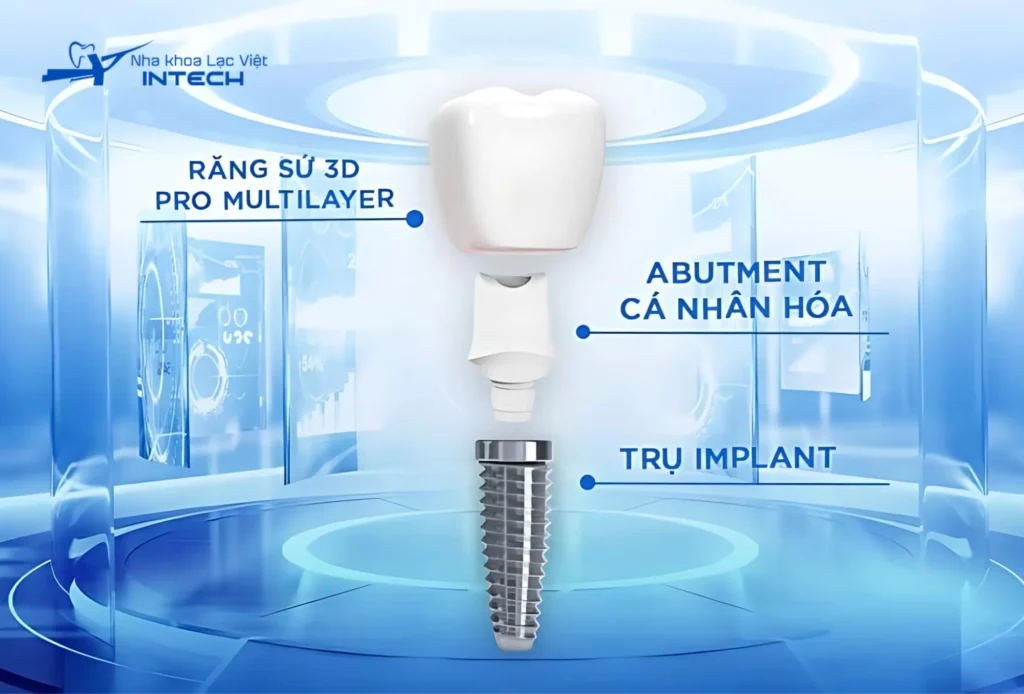
This is why you must ask not only “Which implant brand do you use?” but also:
- Is the abutment customized or prefabricated?
- What type of crown material will be used?
- Can you provide documentation proving origin and quality?
>>See also: What is personalized prosthetic implant?
For full-mouth cases, your understanding must go deeper. You should ask:
- Is the prosthetic arch a chromium-cobalt hybrid, an I-Bar system, or a thimble design?
- Why is that choice appropriate for my case?
These are not technical curiosities. They directly influence hygiene, comfort, durability, and long-term success.
5. Technology: “How Will You Control Precision?”
Implant placement is not a rough mechanical act—it is a millimeter-level medical procedure performed in a complex anatomical environment.
That is why technology is not optional. It is a risk management system.
You should ask whether the clinic uses:
- CBCT 3D imaging for diagnosis
- Digital planning software for simulation
- Surgical guides (máng hướng dẫn phẫu thuật) for accuracy
- Navigation systems such as X-Guide for real-time control
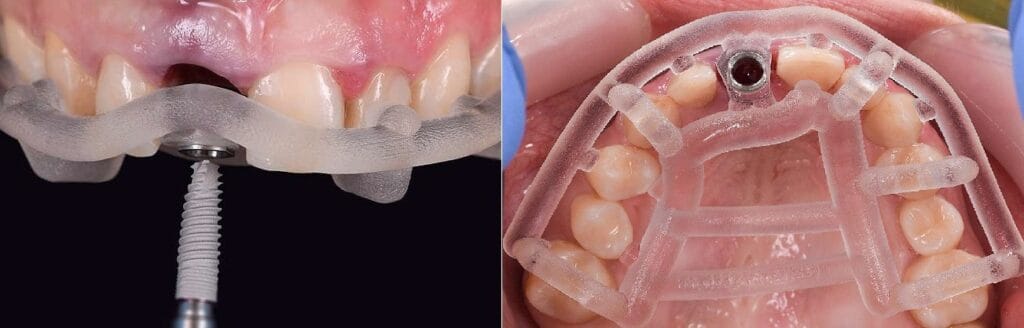
>>See also: What are surgical guides in dentistry?
If bone augmentation is required, you must go further:
- If sinus lifting is needed, what technique is used?
- Does the clinic use magnetic surgery or ultrasonic (piezo) technology?
A clinic aiming to be the best dental implant clinic Vietnam must not only own these technologies—it must use them appropriately, based on clinical indication.
6. The Timeline Question: “Are You Respecting Biology?”
Many clinics market speed. Patients often desire convenience. But implant dentistry follows biological rules that cannot be negotiated.
Bone integration takes time. Healing takes time. Tissue adaptation takes time.
You must ask:
- Is immediate loading suitable for my case, or is it being used as a selling point?
- What is the realistic healing period?
A clinic that respects biology will give you a timeline that may not be the fastest—but will be the safest and most predictable.
7. The Financial Question: “What Is the Real Cost?”
Cost transparency is not about numbers—it is about trust structure.
You should not accept partial pricing. You should insist on understanding:
- What is included in the quoted price
- What is not included
- What additional costs may arise
- What happens financially if complications occur
A serious clinic does not fear this conversation. It prepares for it.
>>See also: dental implant price list
8. The Long-Term Question: “What Happens After I Leave?”
This is perhaps the most critical question for international patients.
Implants do not end with crown placement. They require maintenance, monitoring, and sometimes adjustment.
You must ask:
- What is the warranty policy?
- What does it actually cover?
- What maintenance schedule is required?
- Is remote follow-up available?
A clinic that cannot answer these questions clearly is not offering treatment—it is offering a transaction.
9. Additional Questions an Informed Patient Should Ask
Beyond the core areas above, a truly informed patient should also explore:
- How does the clinic control infection and sterilization?
- Who is responsible if multiple specialists are involved?
- Can I see long-term follow-up cases, not just immediate results?
- How does the clinic handle emergency situations?
- What happens if I am not satisfied with the outcome?
These questions move you from being a “customer” to being a participant in your own treatment outcome.
Conclusion: The Purpose of Asking Questions
The purpose of these questions is not to challenge the clinic. It is to protect your future.
A truly qualified clinic will welcome informed patients. It will answer clearly, document transparently, and guide you through the process without pressure.
To identify the best dental implant clinic Vietnam, you must evaluate four pillars:
- The dentist’s expertise
- The technology applied
- The materials used
- The long-term care system
Missing even one of these increases the risk of failure.If you take the time to ask, understand, and verify the answers to the questions in this article, you will not only choose a clinic—you will choose correctly. And in implant dentistry, that is the difference between a result that lasts a few years and a result that lasts a lifetime.