
When international patients search for “How long does dental implant treatment take in Vietnam?”, the question usually comes from a very practical concern. They may be planning a trip to Vietnam, arranging work leave, booking flights, or comparing treatment timelines between Vietnam, Thailand, Turkey, Mexico, or their home country. Naturally, they want to know how many days they need to stay, how many appointments are required, and when they can receive their final teeth.
However, at Lạc Việt Intech, we believe this question should be understood more deeply. In dental implant treatment, the most important question is not: “Can it be done quickly?” The more important question is: “What process is necessary to create an implant result that is safe, biologically stable, functional, aesthetic, and durable for many years?”
Dental implants are not temporary cosmetic devices. They are artificial tooth roots placed into the jawbone, designed to support crowns, bridges, or full-arch restorations under real chewing forces. Therefore, implant treatment is not simply about placing a screw and attaching a tooth. It is a staged medical process involving diagnosis, surgical planning, implant placement, biological healing, prosthetic design, final restoration, and long-term maintenance. If any step is rushed or simplified incorrectly, the patient may face complications such as implant failure, bone loss, gum recession, food impaction, unstable biting, broken prosthetics, or the need for retreatment.
This is why Lạc Việt Intech does not pursue the goal of “fast implants at all costs.” Instead, every implant case is planned around three core treatment goals: safety, long-term durability, and stable function. All implant patients at Lạc Việt Intech are treated using the DCT personalized implant solution, supported by precision surgery technologies such as a surgical guide or X-Guide navigation, and restored with customized abutments and full-ceramic restorations. The purpose is not merely to shorten time, but to create an implant result that functions naturally, looks harmonious, and remains stable over time.
Why Dental Implant Treatment Cannot Be Judged Only by Speed
Many patients are attracted by advertisements promising “dental implants in 2–3 days” or “same-week final teeth.” In some carefully selected cases, temporary teeth may be placed early for aesthetics or temporary function. But this should not be confused with the completion of biological implant treatment.
After an implant is placed into the jawbone, the body needs time for osseointegration. This is the biological process in which bone cells attach to the implant surface and create a stable connection between the implant and the jawbone. If the implant is loaded too early or restored improperly before biological stability is achieved, the risk of failure increases. In Lạc Việt Intech’s implant education materials, implant success is repeatedly explained as a combination of biological stability, mechanical stability, aesthetics, safety, and convenience in long-term use. A good implant is not merely one that is placed into bone; it must chew well, look natural, remain stable, avoid complications, and be convenient for the patient over the years.
Therefore, when patients ask how long dental implant treatment takes in Vietnam, the honest answer is: it depends on the biological healing of each patient, the implant system used, the bone quality, the number of missing teeth, and the type of final restoration. At Lạc Việt Intech, most implant treatments are divided into two major phases: the surgical phase and the prosthetic restoration phase.
Overview of the Implant Timeline at Lac Viet Intech
The implant process at Lạc Việt Intech usually includes two main stages. The first stage is implant placement, where the dentist collects diagnostic data, plans the implant position, produces the surgical guide and customized healing components, places the implant, and checks early healing. The second stage is prosthetic restoration, performed after the implant has integrated with the bone, usually after 2 to 4 months, depending on the implant type and the patient’s bone quality.
This timeline may sound longer than commercial “instant implant” promises, but it reflects a medically responsible approach. The objective is not simply to finish treatment quickly, but to respect biology, control risk, and create a result that can remain stable for many years.
Phase 1: Surgical Implant Placement
First Appointment: Data Collection, Diagnosis, and Systemic Health Screening
The first appointment at Lạc Việt Intech is not simply a consultation. It is a comprehensive diagnostic session designed to answer several essential questions before surgery: Is the patient medically suitable for implant treatment? Is the jawbone adequate? Where are the important anatomical structures such as nerves and sinuses? What is the patient’s bite condition? What type of restoration should be planned from the beginning?
At this appointment, the patient undergoes CBCT imaging to evaluate the jawbone in three dimensions. This allows the dentist to assess bone height, bone width, bone density, the location of the mandibular nerve, and the relationship between the implant site and the maxillary sinus. This step is essential because implant surgery is performed in an anatomical environment where small errors can cause serious consequences.
The patient also undergoes digital scanning of the teeth, gums, and bite. This is important because implant treatment does not end with the implant fixture. The implant must eventually support a crown, bridge, or full-arch restoration that fits the patient’s bite and soft tissue anatomy. By scanning the teeth, gingiva, and occlusion from the beginning, the dentist can plan the implant position based not only on bone availability but also on the final prosthetic outcome.
In addition, Lạc Việt Intech screens systemic health risks through blood tests and blood pressure evaluation. This is especially important for older patients or patients with diabetes, hypertension, cardiovascular disease, metabolic disorders, or other medical conditions. Implant surgery may be a dental procedure, but it is still a surgical intervention. The clinic’s internal implant materials emphasize that systemic conditions such as diabetes and high blood pressure must be carefully evaluated because they may increase risks such as infection, bleeding, poor healing, or medical complications during surgery.
After this first appointment, the dentist does not immediately proceed to surgery. Instead, the collected data is used to create a detailed treatment plan. The team plans the number of implants, implant positions, surgical pathway, prosthetic direction, and risk control strategy. At the same time, the clinic produces the surgical guide and customized healing abutment used in the DCT solution.
At Lạc Việt Intech, the treatment plan and necessary digital components are typically prepared after a minimum of 24 hours. This waiting time is not wasted time. It is the time required to convert raw diagnostic data into a precise clinical plan.
Second Appointment: Implant Surgery Using DCT and Precision Guidance
The second appointment is the surgical appointment. This is when the implant fixture is placed into the jawbone.
At Lạc Việt Intech, implant surgery is supported by the DCT personalized implant solution. DCT includes four important components: the surgical guide, customized healing abutment, customized prosthetic abutment, and multilayer full-ceramic restoration. In the DCT workflow, the surgical guide helps the dentist place the implant according to the planned three-dimensional position; the customized healing abutment helps shape the soft tissue; the customized prosthetic abutment supports the final restoration; and the full-ceramic crown restores aesthetics and function.
This is very different from a purely conventional implant approach, where the implant may be placed freehand and later restored using standardized components. The DCT philosophy begins with the final outcome in mind. The implant is placed not only where bone is available, but where it can support a stable, aesthetic, and functional final tooth.
Depending on the complexity of the case, the dentist may use a surgical guide or X-Guide navigation. Surgical guide technology helps transfer the digital plan into the patient’s mouth. X-Guide, on the other hand, is a dynamic navigation system that allows real-time guidance during surgery, especially useful in complex anatomical cases requiring high precision. Lạc Việt Intech’s implant technology materials describe these technologies as part of the clinic’s effort to improve placement accuracy and reduce complications.
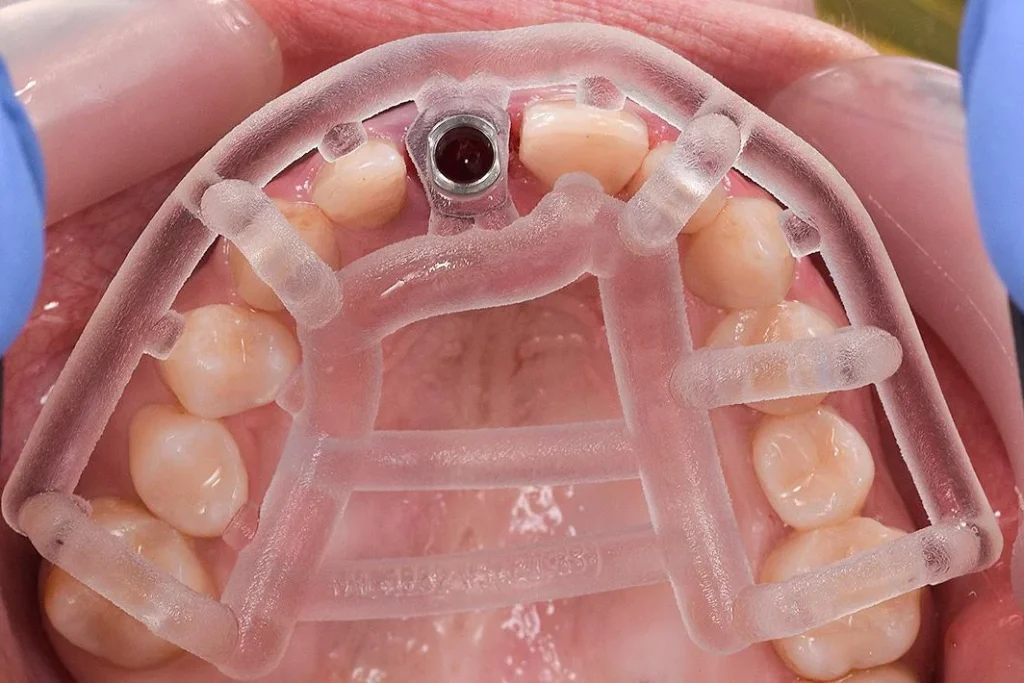
For the patient, the benefit is clear: the implant is not placed based only on hand feeling or estimation. It is placed according to a pre-planned digital pathway designed to protect anatomical structures, optimize force distribution, and support the final restoration.
Third Appointment: Healing Check and Suture Removal After About 5 Days
Approximately 5 days after surgery, the patient returns for a healing check. At this appointment, the dentist evaluates the surgical site, checks soft tissue healing, confirms there are no early signs of infection or abnormal inflammation, and removes sutures if sutures were used.
This visit may seem simple, but it is clinically important. Early healing problems should be detected quickly. For international patients, this appointment also provides reassurance before they continue traveling or return to daily activities.
Additional Appointment if Temporary Teeth Are Needed
In some cases, patients may need temporary teeth after implant placement. This is especially relevant for implants in the aesthetic zone, such as front teeth, or for full-arch implant treatment. Temporary teeth are not the final restoration. Their role is to provide temporary aesthetics, improve patient confidence, and support limited temporary function while waiting for osseointegration.
At Lạc Việt Intech, temporary teeth are used carefully and according to clinical indication. The purpose is not to create the illusion that treatment has been fully completed, but to help the patient maintain appearance and basic comfort during the healing period. The final restoration is still performed only after the implant has achieved adequate biological stability.
>>See more: The Complete Implant Timeline at Lac Viet Intech
The Healing Period: Usually 2 to 4 Months
After phase 1, the implant requires time to integrate with the jawbone. At Lạc Việt Intech, phase 2 is usually performed 2 to 4 months after implant placement, depending on the implant type and the patient’s bone quality.
Patients with good bone quality and favorable anatomy may be ready sooner. Patients with softer bone, bone grafting, sinus-related procedures, or more complex conditions may require a longer healing period. This variation is not a weakness of the process; it is a sign that treatment is being adapted to biology rather than forced into a fixed marketing timeline.
In implant dentistry, patience is not delay. It is part of treatment. The healing period allows the implant to become stable enough to support the final prosthesis under chewing forces. Skipping or shortening this period without proper indication may increase long-term risk.
Phase 2: Prosthetic Restoration
Phase 2 begins after the implant has integrated with the bone. This is the stage where the final teeth are designed, tested if necessary, and installed.
First Appointment in Phase 2: X-ray Evaluation and Digital Impression
At the first restoration appointment, the dentist takes an X-ray to evaluate osseointegration and confirm that the implant is ready for restoration. This is important because the final crown or full-arch prosthesis should only be made when the implant foundation is stable.
After that, the clinic takes a digital impression. At Lac Viet Intech, impression-taking is fully digital. Instead of traditional impression materials, the clinic uses scanning technology to record the implant position, gum contour, bite relationship, and surrounding teeth. This improves patient comfort and increases the precision of the prosthetic design.
Digital scanning also fits the DCT philosophy. The final restoration is not made as a generic tooth. It is designed based on the patient’s actual anatomy, soft tissue contour, and functional requirements.
Second Appointment for Full-Arch Cases: Trial Prosthesis for Aesthetics and Bite
For single-tooth implant cases, this appointment is usually not needed. But for full-arch implant cases, the patient returns about 24 hours after the first restoration appointment for a trial prosthesis.
This trial prosthesis is usually a printed test arch. The dentist uses it to check aesthetics, smile line, lip support, vertical dimension, phonetics, bite relationship, and functional comfort. This step is extremely important in full-mouth rehabilitation because the final prosthesis does not replace one tooth; it rebuilds an entire dental arch.
At this stage, the dentist adjusts key parameters on the printed trial arch. Once the aesthetics and occlusion are properly calibrated, the trial result becomes the reference for producing the final prosthesis.
This step reflects Lạc Việt Intech’s philosophy: the final restoration should not be guessed. It should be tested, adjusted, verified, and then fabricated.

Final Appointment: Placement of the Final Restoration
The final restoration is usually installed 2 to 4 days after the trial stage, depending on the complexity of the case. For single-tooth implants, the process may be simpler and faster because no full-arch trial is required. For full-arch cases, the final prosthesis requires more detailed design, production, and adjustment.
At this appointment, the dentist installs the final crown, bridge, or full-arch prosthesis. The bite is checked carefully. The gum response is evaluated. The patient is instructed on cleaning, chewing, maintenance, and follow-up.
At this point, the implant treatment is functionally completed, but the care process continues.
Follow-Up and Maintenance at Lac Viet Intech
One of the important differences at Lạc Việt Intech is that post-treatment care is treated as part of the implant service, not an optional add-on. Follow-up and maintenance are provided completely free of charge.
In the first year, patients are advised to return twice, with appointments approximately 6 months apart, if their schedule allows. At the end of the second year, the patient should return once. After that, a maintenance visit every 5 years is recommended.
At each follow-up appointment, the dentist checks the bite, evaluates the gum tissue response, takes X-rays to examine bone response, cleans and maintains the prosthesis, and checks the implant structure. This is essential because implant teeth, like natural teeth, exist in a biological environment. The gums, bone, bite, and prosthetic components may change over time. Regular maintenance allows early detection of problems before they become serious.
For international patients, the clinic’s follow-up philosophy is especially valuable. Many foreign patients fear that after returning home, they will not know what to do if discomfort or uncertainty occurs. A structured maintenance system reduces this anxiety and shows that the clinic accepts long-term responsibility, not only surgical completion.
What Makes the Implant Process at Lac Viet Intech Different?
The difference is not only in the number of appointments. It is in the logic behind each appointment.
The first appointment exists to collect complete data and screen risk. The second appointment exists to place the implant according to a precise plan. The third appointment exists to monitor early healing. The waiting period exists to respect osseointegration. The restoration appointments exist to create a final tooth or full arch that is functional, aesthetic, and stable. The follow-up appointments exist to protect the result over time.
In other words, the Lạc Việt Intech process is not designed around speed. It is designed around outcome quality.
Every implant surgery is performed by implant-focused doctors. The clinic uses advanced and appropriate technologies, including surgical guides and X-Guide when indicated. Materials are genuine and clearly selected. Costs are transparent. Warranty policies are long-term, with a commitment to renewal rather than patchwork repair, and without additional hidden costs under the stated policy.
This is why the question “How long does dental implant treatment take in Vietnam?” should never be separated from the question “What kind of result do I want?” If a patient wants a result that is safe, durable, aesthetic, and stable, the treatment must be given enough time to be planned, executed, healed, restored, and maintained properly.
Conclusion: How Long Does Dental Implant Treatment Take at Lac Viet Intech?
For most patients, dental implant treatment at Lạc Việt Intech takes place in two phases. The surgical phase usually requires about 3 appointments, with an additional appointment if temporary teeth are needed. After implant placement, the patient waits approximately 2 to 4 months for bone integration, depending on implant type and bone quality. The prosthetic phase usually requires 2 to 3 appointments, depending on whether the case is single-tooth or full-arch.
So, the practical answer is: a complete implant treatment usually takes 2 to 4 months, with several carefully structured appointments.
But the deeper answer is this: at Lac Viet Intech, implant treatment takes as long as necessary to create a result that is safe, stable, functional, aesthetic, and maintainable. The clinic does not ask, “How fast can we finish?” It asks, “What is the right process to protect the patient for the long term?”
That is the philosophy behind DCT. That is the reason for guided surgery and X-Guide. That is why customized abutments and full-ceramic restorations are used. And that is why follow-up and maintenance remain part of the treatment journey even after the final tooth is placed.