
When patients begin researching tooth replacement, the first question they ask is what are dental implants. This is the right starting point, because understanding the nature of dental implants is essential before making any treatment decision. In modern dentistry, dental implants are not simply artificial teeth; they are a comprehensive biological and mechanical solution designed to restore missing teeth in the most stable, aesthetic, and long-lasting way.

What Is a Dental Implant?
To answer what is a dental implant, it is essentially an artificial tooth root made of biocompatible material, typically titanium, which is surgically placed into the jawbone to replace a missing tooth. However, from a professional perspective, dental implants go far beyond just replacing a root. They restore the entire tooth system, including function, structure, and aesthetics.
When a natural tooth is lost, not only the visible crown disappears but also the root inside the bone. This leads to bone resorption, shifting teeth, and functional imbalance. Dental implants address this root cause by replacing the missing root, preserving bone structure, and creating a stable foundation for long-term restoration.
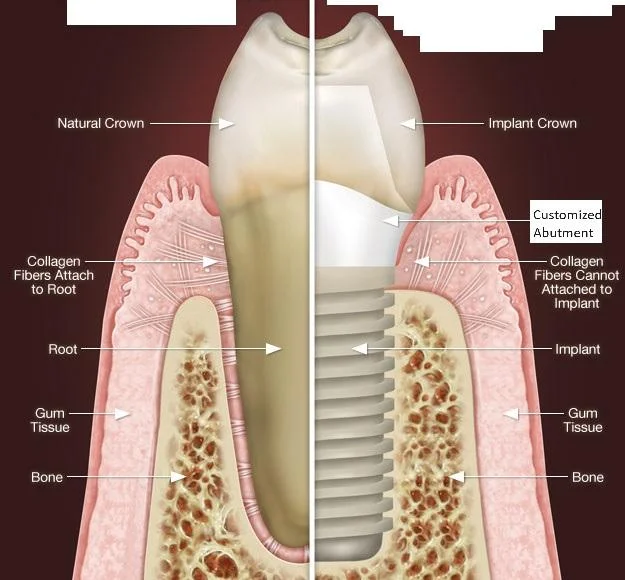
Implant Structure – Components of a Dental Implant
To understand what are dental implants, it is essential to look at their structure, because long-term success depends on how well each component works together as a unified system.
A dental implant consists of three main parts:
Implant Fixture (Artificial Root):
This is the part placed deep into the jawbone, acting as the foundation of the implant and supporting chewing forces. There are many types of implant fixtures with significant differences in design, surface technology, and material quality, which directly affect cost and long-term outcomes. High-quality implants are designed to improve bone integration and stability, while lower-quality implants may increase the risk of complications over time.

Abutment (Connector):
The abutment connects the implant fixture to the crown and plays a key role in force transmission and soft tissue shaping. It has two parts: the subgingival portion, which supports gum health and aesthetics, and the supragingival portion, which supports the crown. Abutments can be stock (pre-made) or customized (CAD/CAM), and are typically made from titanium for strength or zirconia for better aesthetics.

Crown (Prosthetic Tooth):
The crown is the visible part that restores function and appearance. It must be properly designed to ensure correct occlusion and force distribution, reducing the risk of mechanical complications. Crowns can be made from PFM, monolithic zirconia, or layered zirconia, and may be standard or customized. Customized crowns offer better fit, aesthetics, and long-term performance.

In modern dentistry, these components function as an integrated system, where precision and compatibility are critical to achieving stable, aesthetic, and long-lasting results.
How Dental Implants Work
To fully understand how dental implants work, we must look at both biological and mechanical principles.
Biologically, after placement, the implant undergoes osseointegration, where bone cells grow and attach directly to the implant surface, forming a strong bond. Modern implant surfaces are engineered to accelerate and enhance this process.
Mechanically, once integrated, the implant functions like a natural root. Chewing forces are transmitted from the crown through the abutment to the implant and into the bone. If the implant is placed correctly in 3D position, forces are evenly distributed, ensuring long-term stability. If not, complications such as loosening, fracture, or bone loss may occur.
Types of Dental Implants – 3 Main Approaches
When discussing types of dental implants, the most important distinction is not brand or origin, but the method of placement and treatment philosophy.
1. Freehand Implant (Experience-Based)
The implant is placed based on the surgeon’s experience and clinical judgment. While skilled doctors can achieve good results, accuracy depends heavily on subjective skill.
2. Digital Implant (Guided Surgery)
This method uses surgical guides or navigation systems (such as X-Guide) to place implants precisely according to a 3D treatment plan. It significantly improves safety and accuracy, especially near critical anatomical structures.
3. Personalized Implant (Advanced Level)
This is the most advanced approach, combining digital implant placement with customized prosthetics using scanning and CAD/CAM technology. Every component, from healing abutment to final crown, is tailored to the patient, optimizing aesthetics, function, and long-term stability.
>>> See more: DCT personalized dental implant solution: one – time implant, peace of for a lifetime.
Who Can Get Dental Implants?
Most adults with missing teeth are candidates for implants. This includes patients with single tooth loss, multiple missing teeth, or full arch loss.
However, successful implantation requires proper evaluation of:
- Bone quantity and quality
- General health condition
- Gum and soft tissue health
- Occlusion (bite relationship)
Even elderly patients can receive implants if treatment is carefully planned and minimally invasive techniques are applied.
However, not everyone is immediately suitable for dental implant treatment. Certain conditions may increase surgical risks or affect the success of osseointegration, including:
- Patients under 18 years old, whose jawbone development is not yet complete
- Individuals with uncontrolled hypertension
- Patients with uncontrolled diabetes
- Patients with serious cardiovascular diseases
- Patients who have undergone chemotherapy or radiotherapy within the past five years
- Pregnant women
In these cases, dental implant treatment should be postponed or carefully evaluated by a qualified specialist to ensure safety and predictable outcomes.
Dental Implant Procedure – Step by Step
A complete dental implant treatment is typically divided into two main stages, separated by a healing period ranging from 3 weeks to 3 months, depending on bone condition, technology used, and the type of implant selected.
Stage 1: Implant Placement Surgery
This stage focuses on placing the implant fixture into the jawbone and is the foundation for long-term success.
- Examination & 3D Planning:
Comprehensive assessment using clinical examination and 3D imaging to determine bone condition and create a precise treatment plan - Implant Placement:
Surgical insertion of the implant into the jawbone, ideally guided by digital technology to ensure accuracy and safety - Initial Healing Phase:
The implant begins the osseointegration process, where it gradually bonds with the surrounding bone
Stage 2: Prosthetic Restoration (After 3 Weeks to 3 Months)
This stage begins after initial healing and focuses on restoring function and aesthetics.
- Healing Abutment Placement:
A healing abutment may be placed (either at this stage or immediately after surgery in some cases) to shape the gum tissue - Impression Taking / Digital Scanning:
Accurate measurements are taken to design a well-fitting prosthetic crown - Crown Fabrication & Placement:
The final crown is produced (often using CAD/CAM technology) and attached to the implant, completing the restoration
This two-stage approach allows for proper biological healing and precise prosthetic design, ensuring that the final implant is stable, functional, and aesthetically natural.
Risks of Dental Implants and How to Avoid Them
Implant risks can occur at different stages:
- During surgery: nerve injury, sinus perforation, bleeding
- Early stage: infection, failure of osseointegration
- Long-term: peri-implantitis, mechanical complications
The causes typically relate to four factors:
- Doctor skill
- Technology used
- Material quality
- Patient condition
Prevention strategy:
Choose a clinic with strong expertise, precise technology, high-quality materials, and a clear treatment plan.
>>> See more: 5 Risks of Choosing Vietnam for Dental Implants – What International Patients Should Know Before Deciding
How Much Do Dental Implants Cost?
The cost of dental implants varies depending on:
- Implant brand and material quality
- Doctor expertise
- Technology used (freehand vs digital vs personalized)
- Type of prosthetic restoration
A common mistake is focusing only on the implant price, ignoring abutment, crown, and overall treatment quality. A low initial price may lead to higher long-term costs if complications occur.
How to Choose a Safe Dental Clinic for Implants
To ensure safe and successful treatment, patients should evaluate clinics based on:
1. Doctor Expertise
Specialized training and real clinical experience.
2. Technology
Availability of digital planning and guided surgery systems.
3. Materials
Transparent, high-quality, and globally recognized implant systems.
4. Aftercare & Warranty
Long-term follow-up and clear responsibility for outcomes.
The most important principle is not choosing the cheapest option, but choosing the safest and most predictable solution.
FAQ – Common Questions About Dental Implants
The procedure is typically painless with proper anesthesia and modern techniques.
With proper care, implants can last decades or even a lifetime.
Yes, when performed by experienced doctors using proper technology.
It can range from a few weeks to several months depending on the case.
If you are simply looking for the best dental implant clinic in Vietnam, the most important step is not choosing the cheapest option, but choosing a clinic that prioritizes safety, precision, and long-term outcomes. A properly planned implant is not just a treatment—it is a lifelong investment in your oral health.
Pingback: Are Dental Implants Safe? 7 Risks You Must Know